Define Singapore-Based SaaS Tools and Explain Selection Criteria
The term “Singapore-based SaaS tools” refers to software-as-a-service applications built, hosted, or primarily headquartered in Singapore, designed specifically to address regional regulatory standards, business practices, and end-user support expectations in this city-state. For local enterprises, leveraging products created and operated by Singaporean companies offers tangible advantages—ranging from compliance with the Central Provident Fund (CPF) and country-specific employment policies, to timezone-aligned customer support and direct understanding of local workflows. However, the market is peppered with global SaaS brands claiming local relevance, making it essential to set a bar for what “Singapore-based” really means in a practical, operational context.
Shortlisting these solutions is never as simple as picking the company with a “.sg” address. Experienced evaluators should look for:
- Entity Domicile: Is the SaaS vendor registered, headquartered, and substantially staffed in Singapore, or is the local presence superficial?
- Regulatory Compliance: Does the solution offer out-of-the-box, maintained support for key local regulations—e.g., CPF rates for payroll, Skills Development Levy, MOM reporting?
- Data Residency and Security: Where is customer data hosted? Local data residency significantly impacts enterprise adoption in regulated industries.
- Direct Local Support: Is there a Singaporean support team, or does the business rely on APAC-wide or offshore helpdesk agents?
- Feature Localization: Are key workflows (shift scheduling, invoicing, leave management) adapted to the Singapore context, or simply generic with language translation?
- Integration with Local Services: Do APIs, connectors, and export options work natively with local accounting platforms, government portals, or banking APIs?
The reality is that many regional and global SaaS vendors lack critical integration and compliance features for Singapore. Therefore, the evaluation must move beyond basic vendor claims. It should include functional trials and targeted interviews, with IT and business process owners mapping each tool’s real compatibility into existing operations.
Talenox: Payroll and Employee Administration Purpose-Built for Singapore
Talenox positions itself as a next-generation HR and payroll SaaS solution developed and maintained in Singapore. Its primary audience includes SMEs and growing mid-sized businesses seeking compliance-led automation without heavyweight enterprise HR complexity.
Functional Workflows and Local Specialisation
Talenox’s utility begins with Singapore Employment Act compliance baked into its payroll engine. Businesses can trust CPF calculations, IR8A preparation, NSmen payments, and MOM registry reporting, thanks to regularly updated statutory tables and integration points. Unlike many foreign HR SaaS tools, Talenox’s leave management supports local holidays, nuanced part-time/casual employment scenarios, and integrates tightly with Singapore banks for direct deposit via GIRO.
Technical Friction: Data Handling and Change Management
Despite being a leader in compliance automation, Talenox has constraints. Migrating historical payroll data from legacy on-premise software (e.g., MYOB or Sage) often involves manual data transformations. The platform’s API and export formats are serviceable but limited compared to US or EU-centric enterprise payroll providers, especially when bridging with custom ERP instances.
Additionally, businesses with regional entities may find Talenox less flexible beyond Singapore, Malaysia, and Hong Kong—requiring either parallel deployments or manual harmonisation for regional groups.
The Hidden Trade-Offs
- Pros: Reliable compliance with CPF, IRAS, and MOM; responsive local support; plug-and-play bank integrations for Singapore.
- Cons: Multi-country support requires separate modules; limited integration with global ERP/HR suites; still maturing for multi-level approvals or niche union rules.
In practice, Talenox works best when Singapore payroll is a strategic focus, and the bulk of the organisation’s headcount is local.
StaffAny: Shift Scheduling and Workforce Operations for Frontline Teams
StaffAny targets operationally intensive employers (retail, food service, logistics) with shift-based workforces. Its value proposition is less about generic HR administration and more about wrangling time-sensitive shift scheduling, attendance, and operations—enabling compliance while improving efficiency for Singapore’s unique regulatory environment.
Operational Features and Workflow Automation
One of StaffAny’s major strengths is its mobile-first design built for shift workers and supervisors. Clock-ins use location-aware punch mechanisms to prevent “buddy punching” or offsite fraud—a critical need in Singapore’s domestic service and F&B sectors. Automated roster generation factors in Singapore’s overtime rules, mandatory rest days, and public holiday rates, minimising payroll leakage due to scheduling errors.
Integration Realities and Deployment Considerations
Integration with Talenox is supported but may need custom middleware to reconcile unique pay codes or allowances. Larger enterprises may encounter friction when seeking deep integrations with global ERP or HR systems, as StaffAny remains focused on local SME and chain retail segments.
For mid-sized companies, technical onboarding usually completes within 2–4 weeks. Yet adoption sometimes falters in unionised or highly regulated environments with non-standard contracts, requiring manual exceptions management. Reporting customization is weaker than what is available in enterprise platforms like Kronos or SuccessFactors.
- Advantages: Fast onboarding; tailored for Singapore’s retail/hospitality labour laws; accurate, location-based attendance verification.
- Limitations: Less suitable for salaried (non-shift) workforces; reporting customisation is limited; integrations outside the StaffAny ecosystem may lack depth.
Overall, StaffAny is constructed for Singaporean shift workforce operations, bridging regulatory and operational complexity for businesses needing granular, compliant scheduling.
Deskera: Integrated Business Management for SMEs with Regional Ambitions
Deskera blends finance, CRM, inventory, payroll, and sales management into a modular cloud suite. Its roots as a Singapore-founded business are visible in its statutory feature set and documentation, although its ambitions and deployments have expanded throughout Southeast Asia.
Feature Depth and Technical Maturity
Deskera’s core modules—Books, CRM, and People—interoperate via a shared database. For Singapore users, it offers automatic GST calculation and reporting, CPF payroll automation (with direct IRAS filing), and support for popular local banks (UOB, OCBC) for reconciliations and payments. Embedded invoicing and expense functions are mapped to local chart-of-accounts structures, a feature non-local platforms typically lack out of the box.
However, API coverage is broad but not always deep; integrations into custom third-party apps often require Deskera’s professional services or offshore partners. Businesses upgrading from spreadsheets or legacy single-module systems will encounter change management challenges—users must learn a full cloud suite rather than adopting a single-point automation tool.
Deskera’s Enterprise Trade-Offs
- Strengths: Reliable Singapore GST and payroll support; manages multi-company and multi-currency operations; single cloud-native platform for key SME business needs.
- Challenges: Occasional complexity overload for micro-SMEs; reporting depth inferior to specialised vendors; some advanced workflow automation requires additional coding or services.
Deskera sits in the sweet spot for Singapore SMEs seeking scalable, “out-of-the-box” integration of finance, HR, sales, and operations—but those needing highly bespoke reporting or best-of-breed depth may find limitations.
SleekFlow: Customer Conversations and AI Workflows for Digital-First Engagement
SleekFlow is engineered for omnichannel customer engagement—prioritising WhatsApp, webchat, Instagram, Facebook, and emerging messaging channels. Singapore’s retail, F&B, and eCommerce players use it to unify fragmented customer conversations, automate follow-ups, and trigger operational workflows.
Real-World Use Cases and AI Automation
SleekFlow’s workflow engine allows rule-based routing (e.g., direct inquiries in English to domestic staff, Chinese to cross-border agents) and triggers for automated actions like order updates, appointment bookings, or loyalty points reminders. Its AI capabilities centre on conversation summarisation, sentiment scoring, and first-level query parsing—fast-tracking frequently asked questions and enabling agent escalation for complex cases.
API hooks allow basic CRM integration, but businesses seeking native tie-ins to omni-channel retail platforms (e.g., Shopify, WooCommerce), Singapore-localised ERPs, or payment providers may require technical intervention. The learning curve is mild for agents but steeper for admins configuring multi-lingual workflows or AI-triggered actions.
Trade-Offs and Operational Constraints
- Pros: Comprehensive channel coverage; native WhatsApp Business API integration; responsive local support.
- Cons: Advanced workflow automation depends on enterprise plan; CRM connectors may be limited compared to global vendors; data export options for non-conversation data are less extensive.
SleekFlow’s value is highest for Singapore businesses using WhatsApp and multiple social channels as primary customer contact points, rather than classic website/email-driven models.
Compare Business Fit: Use Case, Not Arbitrary Rankings
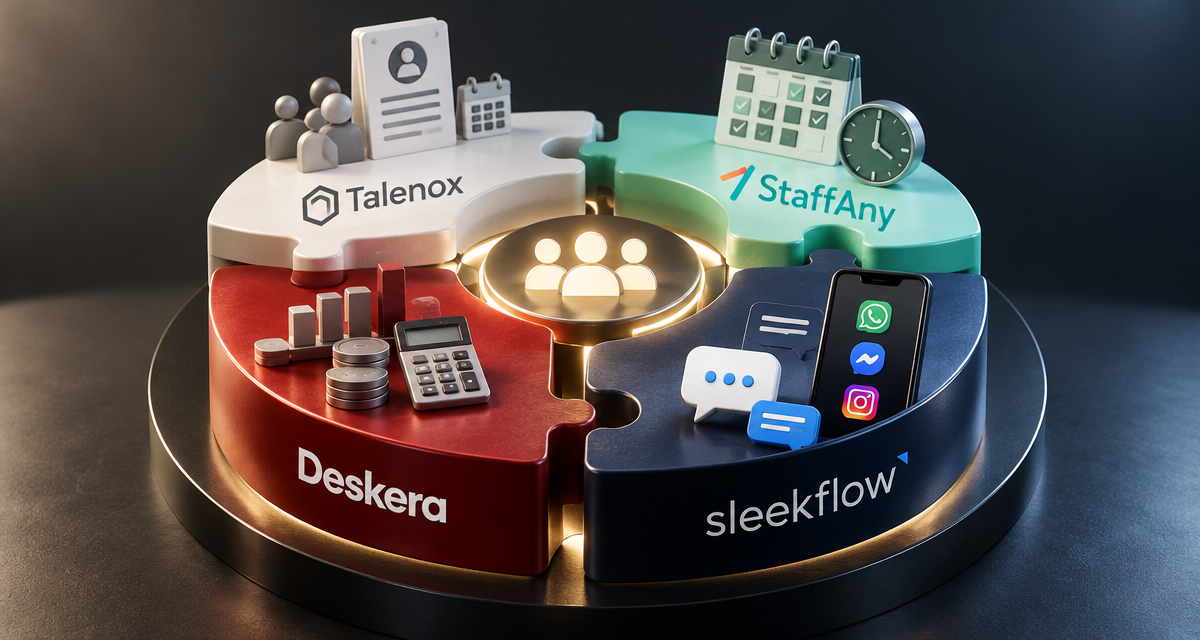
Credit goes to the Singapore SaaS sector for solving sharp, well-scoped business problems—but attempting to “rank” these disparate platforms invites operational error. Each is purpose-built for a business function:
- Talenox: Payroll, statutory compliance, and HR administration (core for white-collar, SME, and multi-payroll admin teams).
- StaffAny: Roster management and shift automation for frontline/operational managers in F&B, retail, and services.
- Deskera: All-in-one ERP for SMEs spanning finance, inventory, CRM, and HR with native Singapore compliance.
- SleekFlow: Customer engagement and conversational automation via omnichannel chat, optimised for retail, ecommerce, and service-driven brands.
The rational approach is to evaluate a solution’s functional fit versus business priorities:
- Map pain points (payroll errors, shift mismanagement, siloed customer messaging, financial confusion) to target tool categories.
- Test workflow compatibility with pilots or sandboxes rather than solely relying on demo scripts or sales collateral.
- Assess candidate solutions through user-level workflow simulation—do daily tasks become faster, more accurate, or easier to audit?
Calling out a “best” SaaS is unhelpful unless you define your business function and workflow ownership. True value comes from fit and integration, not arbitrary platform comparisons.
Verify Singapore-Relevant Workflows and Integration Options
Serious due diligence goes beyond surface-level claims by confirming each SaaS tool’s operational fit:
- Can you configure payroll periods that match Singapore’s banking cut-off dates—without clumsy workarounds?
- Does shift scheduling auto-flag breaches of local overtime or public holiday rules?
- Is there a native IRAS (Inland Revenue Authority of Singapore) e-submission or is this a manual export requiring separate upload?
- Are API endpoints accessible and sufficiently documented to connect with local fintech, payment, or HRIS platforms?
- Does customer conversation software natively support local messaging platforms—or are global-only platforms, like Slack, the default?
IT and operations teams should rigorously test for error-handling, edge-case compatibility, and sandbox integration prior to rollout. This step avoids post-implementation surprises—such as discovering apparent automation actually requires manual CSV file shuffling.
Assess Local Support and Onboarding Experience
Vendor support in Singapore is a tangible differentiator. “Local office” does not guarantee fast, context-aware troubleshooting:
- Talenox and StaffAny offer direct, timezone-aligned phone and chat support staffed by in-country product experts, not just APAC-level reps.
- Deskera maintains a Singapore hub, but escalates some technical issues to regional centres, which may introduce latency for complex accounting or workflow issues.
- SleekFlow focuses its onboarding via dedicated account managers and in-product support widgets, with hands-on setup for enterprise clients.
Typical onboarding can range from all-remote and self-service (for lightweight payroll-only deployments) to white-glove support including migration plans, onsite training, and admin coaching. Prospective buyers should specifically ask:
- Who handles Level 2/Level 3 technical cases, and what are the SLA commitments?
- How is knowledge transferred in cases of software updates or new statutory requirements?
- Is there Singapore-specific training material and support hotline, or only globalised documentation?
For many Singaporean businesses, true value is often found in rapid, expert local support—especially during critical payroll cycles or system go-live periods.
Check Data Export, API, and Subscription Limitations
A make-or-break criterion for enterprise buyers is data ownership, portability, and their real options for integration, especially for audit, financial reporting, or CSR obligations:
- Does the platform enable full data export in flexible formats (CSV, Excel, JSON, API) without vendor lock-in, or do you face email-based “data request” friction?
- Are all data objects—payroll periods, conversations, shift logs, transaction details—accessible, or only limited to surface-level analytical reports?
- What happens to your data if you downgrade or cancel a subscription? Are there retention, egress, or archivability options aligned with Singapore’s PDPA (Personal Data Protection Act)?
- Are API limits or usage quotas transparent, and do they allow for bespoke integration with ERP, data warehouse, or regional platforms?
Subscription tiers often restrict more than just user counts or feature modules. For example, SleekFlow gates advanced automation and certain integrations behind higher-priced enterprise tiers; Deskera restricts multi-company and some API access above basic levels. Enterprise buyers should simulate renewal, downgrade, and exit scenarios to avoid data hostage situations.
Shortlist by Business Function and Pilot Requirements
The objective, best-practice approach is to construct a shortlist by aligning core workflow requirements to SaaS tool strengths:
| Tool | Primary Use Case | Business Sizing | Notable Singapore Features | Integration Options | Local Support? | Best Pilot Scenario | Key Subscription Limitations |
|---|---|---|---|---|---|---|---|
| Talenox | Payroll, leave, and HR compliance automation | SMB to mid-sized domestic teams (up to 500 employees) |
|
APIs, CSV export, Deskera/StaffAny connectors | Dedicated in-country team | Replace outdated payroll software or manual payroll-linked spreadsheets | Multi-country support, advanced analytics locked behind higher plans |
| StaffAny | Shift scheduling, time & attendance automation | Retail, F&B, logistics; chains to large SME |
|
Basic API, Talenox/HRIS export | Singapore-based support & onboarding | Pilot at a high-staff-turnover outlet or branch-based operations | Custom integrations/reporting may require premium tier |
| Deskera | Integrated finance/HR/CRM/Inventory | Southeast Asia SMEs & mid-market; multi-entity compatible |
|
REST API, CSV, Xero/QuickBooks | Singapore office, regional escalation | Trial single subsidiary or small group migration from legacy ERP | Feature gating (API, multi-entity) on higher plans |
| SleekFlow | Customer conversation management, AI-driven workflows | Retail, eCommerce, service businesses (10-100 agents) |
|
API, CRM integration, webhook support | In-country onboarding, account management | Test omnichannel campaign or customer service workflow in live ops | API & full workflow automation on enterprise tiers |
In practice, shortlist two or three candidate platforms per business function. Conduct time-limited pilots using real workflows, not generic test data, to assess true fit, support quality, technical friction, and end-user experience in a Singapore context.