Anthropic IPO: What the Latest Prospectus Reveals About Claude’s Business
What Changed in the 10 November Prospectus
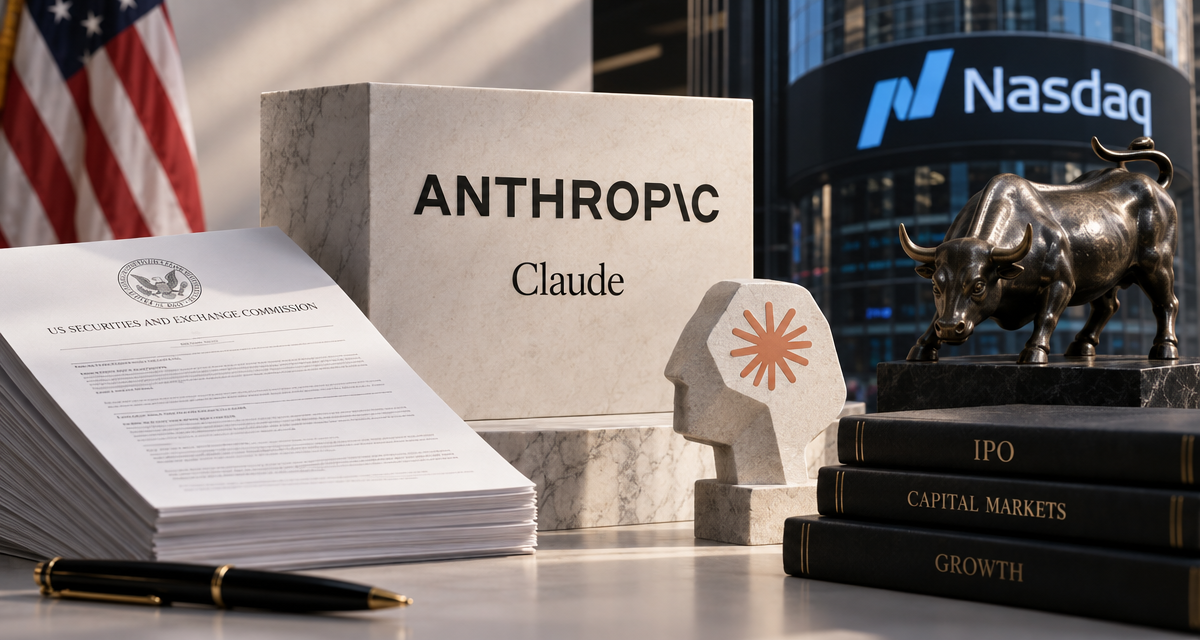
The latest prospectus filed by Anthropic with the US Securities and Exchange Commission marks a significant milestone in the AI developer’s road to listing on Nasdaq. This updated filing introduces clearer operational guidance, more granular financial breakdowns, and sharper disclosures on risks and revenue sources associated with Claude, Anthropic’s flagship AI model suite.
Key changes include:
- Expanded Risk Disclosures: The prospectus now details the regulatory maze in which generative AI firms operate. Notably, Anthropic provides specificity around compliance challenges — such as model training liabilities, copyright exposure, and content moderation risks — that could materially impact long-term valuation.
- Revenue and Customer Segmentation: For the first time, the document outlines revenue breakdowns across enterprise, developer, and channel partner segments. There’s a pivot toward long-term multi-year contracts anchored by minimum compute commitments, with an increased emphasis on usage-based pricing.
- Revised Use of Proceeds: Language is more explicit about R&D allocation, particularly investment into large-scale model training infrastructure and safety alignment research, showcasing how capital will be deployed post-IPO.
- Governance Structure: Clarified details on Anthropic’s trust-based board controls, with emphasis on the limited voting rights available to public shareholders—a rare structure for a technology IPO of this scale.
For CTOs and enterprise buyers, the prospectus signals that Anthropic’s leadership is backing up its responsible AI marketing with demonstrably higher transparency than earlier filings. However, the company still omits certain customer concentration metrics and leaves some computational capacity agreements under NDA, complicating absolute due diligence for shareholders and strategic partners.
The Proposed Share Count and Price Range
Anthropic’s IPO prospectus sets out a proposed range, both in terms of outstanding shares and per-share pricing, that reflects the heightened investor appetite across the generative AI sector while underlining some unique structural nuances. The company aims to issue approximately 15–18 million Class A ordinary shares on Nasdaq, with a preliminary price range of US$64 to US$75, targeting a post-IPO valuation near US$18–22 billion depending on the final allocation and overallotment activity.
Key elements to consider:
- Dual-Class Share Structure: The IPO splits shares between Class A (publicly listed, limited voting rights) and Class B (held by founders, employees, early backers, conferring significant voting power). This structure ensures strategic continuity but introduces governance friction for activist investors and ordinary shareholders, limiting their ability to influence future corporate actions or M&A decisions.
- Lock-Up Agreements: Most early stakeholders are subject to a 180-day lock-up, restricting secondary market volatility but potentially teeing up a crowded pipeline of future share sales once restrictions lapse.
- Pain Points for Analysts: While the price range is in line with recent private AI capital raises, the real valuation test will come as the scale and stickiness of recurring Claude subscriptions become clearer in quarterly reporting post-listing. The lack of detailed customer churn data may challenge near-term price discovery.
These factors sharply distinguish Anthropic’s approach from software IPOs over the past decade. The public float will be relatively small compared to fully diluted shares, limiting trading liquidity and amplifying price volatility until follow-on offerings expand the public share base.
How the US$26 Billion Private Placement Fits In
Parallel to the main offering, Anthropic is closing a US$26 billion private placement involving major hyperscalers and strategic technology partners. This complex transaction inserts deep-pocketed investors directly onto the cap table, well in advance of broader retail investor access.
| Participant Type | Estimated Allocation | Strategic Rationale | Potential Conflicts/Dependencies |
|---|---|---|---|
| Hyperscalers (e.g., AWS, Google) | ~60% | Secures multi-year model hosting and preferential access to new Claude releases, aligns cloud spend with equity upside | Deep infrastructure dependency, preferential compute pricing, exclusivity clauses |
| Venture Capital/PE | ~30% | Long-term appreciation, governance leverage through enhanced preferred rights | Dilution risk for public investors, pressure for early exits |
| Strategic Channel Partners | ~10% | Access to Claude APIs, integration co-development, ecosystem expansion | Possible channel conflicts, integration prioritization disputes |
From an enterprise adoption perspective, this hybrid capital stack lowers operational friction and strengthens Anthropic’s long-term access to compute resources, but it also bakes in non-trivial trade-offs. Dependence on preferred cloud partners could constrain future cross-cloud deployments and complicate negotiations for customers with multi-cloud strategies. Independent software vendors (ISVs) and end customers may face tighter integration timelines or feature release lags due to these strategic commitments.
The private placement’s size relative to the public float also distorts conventional public market signals—the real locus of control (and upside) remains with a handful of large tech conglomerates whose interests may diverge from general equity holders.
What the Filing Reveals About Compute Commitments
Anthropic’s prospectus pulls back the curtain on the massive, multi-year compute agreements underpinning Claude’s AI model lifecycle. These contracts—often inked with hyperscale cloud providers as part of the private placement—define the throughput, redundancy, and failover guarantees necessary for reliable enterprise-scale deployment.
Enterprise AI adoption hinges on dependable model performance and predictable infrastructure cost structures:
- Minimum Usage Commitments: Anthropic discloses that it is contractually obligated to purchase preset tiers of GPU compute and storage, typically measured in exaflops-hours over multiple years. While this secures priority access during periods of chip scarcity, it also exposes Anthropic to the risk of over-provisioning or underutilizing reserved capacity if revenue growth decelerates or contract renewals lag.
- Custom Hardware Optimizations: The filing highlights ongoing co-development with hyperscalers to tailor infrastructure for Claude’s current and next-gen models. For clients, this reduces inference latency and elevates data residency assurance, but it can also lock workloads into a single provider’s stack (e.g., AWS Trainium, Google TPU).
- Operational Trade-Offs: Anthropic’s ability to capitalize on these compute deals rests on flawless orchestration across software (API layer, developer environment, enterprise controls) and hardware. Outages, supply-chain interruptions, or suboptimal workload scheduling could directly impact availability SLAs for paying enterprise users—a non-trivial risk for mission-critical deployments.
The technical friction here is real: integrating with Anthropic’s APIs requires careful planning on the part of customer DevOps teams. Bandwidth, storage, and inference concurrency quotas may apply, especially for regulated sectors or global rollouts. Data migration from legacy NLP or non-foundational AI tools can add BPM and security overhead, especially if customers require bespoke prompt-engineering controls or real-time data peripheral feed integrations.
How Anthropic’s Governance Works
Few technology IPOs have generated as much scrutiny around governance as Anthropic’s. Unlike traditional structures, Anthropic has implemented a “public benefit corporation” overlay, underpinned by a trust-based board system that gives substantial oversight to nonprofit stewards charged with ensuring responsible AI deployment and model alignment with broadly defined societal interests.
Highlights of Anthropic’s governance approach:
- Limited Shareholder Voting Rights: Public investors, even after the IPO, will have only nominal voting power. Key decisions—including model release thresholds, external deployment safeguards, and high-risk client vetting—are effectively insulated from direct market pressure.
- Steward Board: The majority of voting power (via Class B shares and special veto rights) resides with the nonprofit trust and its designated board holders, who can overrule for-profit board decisions on ethical or safety grounds.
- Founder Alignment, Investor Tension: While this structure preserves Anthropic’s founding ethos and creates guardrails against revenue-maximizing but potentially reckless deployments of Claude, it also introduces persistent friction with institutional investors accustomed to conventional US corporate governance, creating potential future legal and M&A ambiguities.
- Disclosure Limitations: The trust’s decision-making procedures and succession plans remain thinly described in the prospectus, a possible red flag for institutional buyers seeking clarity on future model stewardship in scenarios such as a founder departure, regulatory intervention, or catastrophic model failure.
From an enterprise buyer’s lens, the upside is more conservative AI model rollouts and a stated commitment to long-term safety research. The downside: slower responsiveness to individual customer demands, less flexibility on product roadmap acceleration, and greater unpredictability in case of external shock events or governance disputes.
What Remains Unconfirmed Before Trading
Despite the robust detail in the latest prospectus, several material aspects remain undetermined or only partially disclosed in the days leading up to the anticipated public listing.
- Final IPO Pricing and Allocation: Market conditions, changing venture capital sentiment, and the pace of strategic fund allocations could materially shift IPO pricing and the public-to-private share ratio right up until the actual pricing night.
- Detailed Financials (2024–2025): The prospectus offers revenue run-rates and contracted future revenue, but lacks granular forward-looking segment results—especially pipeline conversion rates, customer retention risk, and regional revenue splits (e.g., North America vs EMEA).
- Claude Model Roadmap: While the filing hints at “Claude 3.0” and expanded API/vertical support, exact release dates, commercial terms, and technical specs for future model generations remain under NDA with select partners. This affects procurement planning for enterprise buyers.
- Antitrust/Regulatory Outcomes: Ongoing investigations (both US and EU) into generative AI models’ societal risk, market power consolidation, and interoperability could force Anthropic to modify API access models, pricing, or neutrality guarantees after the IPO.
From the standpoint of an IT leader considering mission-critical Claude integration, these open issues introduce procurement uncertainty. Budgeting for future usage, integrating with compliance frameworks, and negotiating custom service-level agreements (SLAs) will all depend on how these variables settle after shares begin trading.
Claude Platform Comparison: Deployment, Governance & Partner Dependencies
| Claude Model Tier | Target Use Case | Deployment Options | Minimum Compute Commitment | API Features | Governance Controls | Partner Dependency |
|---|---|---|---|---|---|---|
| Claude Instant | Real-time chatbot, mobile integration, light analytics | Cloud API (SaaS), via partners | Pay-as-you-go, low minimums | Basic prompt, entity extraction, limited batch | Standard Anthropic trust oversight | Low (Multi-cloud enabled) |
| Claude Enterprise | Advanced data analysis, secure enterprise workflow, vertical AI copilot | Dedicated cloud, VPC isolation | Annual contract, minimum reserved GPU quota | Advanced context window, callback hooks, custom workflows | Managed by Anthropic and trust board | Moderate (Linked to partner cloud agreements) |
| Claude Labs (Private Preview) | Experimental, developer sandbox, bespoke vertical models | Invite-only, limited partner datacenters | Negotiated per project | Full API access, unrestricted context | Tight oversight, early termination risk | High (Restricted to specific cloud partners) |
This breakdown shows how Claude’s deployment and usage flex around different partnership and governance structures, with tangible effects on technical integration planning, operational agility, and legal risk posture for enterprise clients and developers alike.