How to Connect Warehouse Robots From Different Vendors
Inventory Robot Fleets and Warehouse Systems
Integrating fleets of mobile robots—often sourced from multiple vendors—into a single warehouse operation goes far beyond simply plugging in new hardware. It starts with inventorying your existing robotic assets, understanding their intended workflows, and mapping their control architectures to your warehouse management system (WMS) ecosystem.
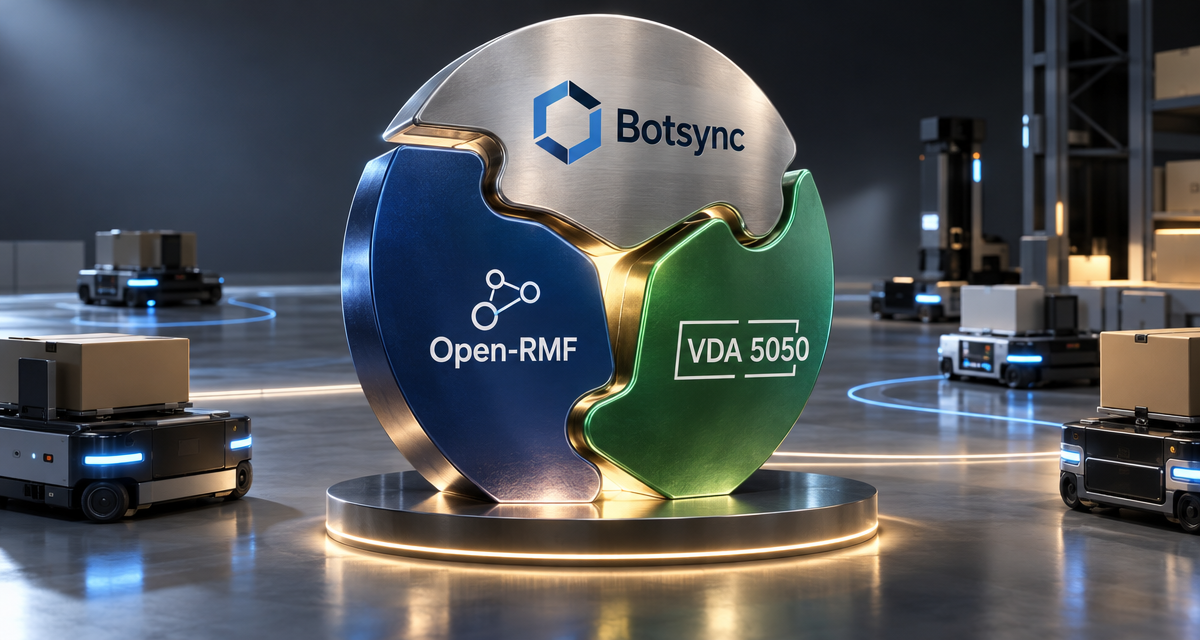
Warehouse robot integration projects quickly encounter technical friction at this stage. Robots from Botsync, for instance, may offer native connectors for specific WMS software, while others in your floor plan—legacy autonomous guided vehicles (AGVs) or new autonomous mobile robots (AMRs)—may only expose proprietary APIs or support emerging standards like Open-RMF or VDA 5050.
Key inventory tasks and alignment points include:
- Robot Model Capabilities: Identifying navigation tech, payload limits, available interface protocols, and software versions.
- Physical Interoperability: Verifying region coverage, docking/charging systems, and feasible mixing zones within established storage layouts.
- System Interconnects: Mapping data pathways between vendors’ fleet management software, traffic control modules, and the warehouse’s primary orchestration system.
The most common operational pitfall: assuming robots will work as a joint fleet without deep-dive compatibility and protocol validation. Without careful inventory, even market-leading bots may fail to communicate, resulting in route conflicts, task duplication or dangerous collisions.
Separate Fleet Coordination From Individual Robot Control
A foundational principle in advanced warehouse automation: decouple fleet-level task dispatch and navigation from device-level motion control. Directly managing every robot via bespoke API calls or vendor apps leads to brittle, unscalable architectures and exposes you to vendor lock-in.
Modern warehouse robot integration platforms—like Open-RMF and Botsync—solve this by implementing “meta-fleet” coordination. Instead of micro-managing every device, warehouses assign work to entire fleets, letting each vendor’s controller handle its native units, while site-wide scheduling, scheduling, and route arbitration are abstracted.
This separation brings several hard-nosed operational advantages:
- Centralized visibility and analytics across heterogenous hardware.
- Reduced API complexity—interface with one fleet orchestrator, not dozens of robot drivers.
- Flexibility: Swap, upgrade or onboard new robot types without rearchitecting your WMS.
But this abstraction introduces trade-offs. Some device-level features—like custom sensor data, predictive diagnostics or firmware-specific optimizations—may be hidden or watered down when routed through a high-level fleet protocol. Advanced users must ensure meta-fleet controllers expose escape hatches for direct vendor-level integrations when truly needed.
Check Interface and Protocol Compatibility
The interface layer is often the most brittle and problematic area in any mixed-vendor robot deployment. The warehouse control system must broker communications between each robot’s native API, communication bus, and the coordination middleware (e.g., Open-RMF or VDA 5050).
Protocol mismatches—such as one fleet exposing MQTT, another using HTTP REST endpoints, and a third offering only legacy PLC triggers—cause costly delays or, worse, unreliable system behavior. This is a prime reason why industry-standard protocols have emerged:
- Open-RMF provides open, extensible APIs for task management, location updates, and facility map sharing between disparate fleets.
- VDA 5050 (backed by European automotive logistics) is a unifying fleet-agnostic messaging protocol, aiming to standardize robot–control system communication, regardless of vendor.
When selecting robots or middleware, scrutinize:
- Supported protocol (and version) for each robot and the coordination platform
- Authentication, encryption, and data security mechanisms—many protocols are immature in production security
- Update cadence: Are your robots’ firmware and the fleet controller regularly maintained to align protocol changes?
Integration projects should budget for protocol adapters or gateways, particularly when mixing legacy or region-specific robot models. This work can be tedious, and ongoing maintenance is required as vendors evolve at uneven paces.
Map Task Dispatch and Traffic Coordination
A warehouse’s real-world gains from robot fleets are measured by their ability to assign tasks efficiently and prevent traffic jams. Task dispatch involves assigning cleaning, picking, transport, or inventory jobs based on fleet capabilities, battery health, and current position. Advanced traffic coordination—critical in mixed-fleet scenarios—prevents double-booking of tight aisles, dock access, and charging stations.
Platforms like Open-RMF and Botsync offer abstracted traffic managers:
- Dynamic, real-time route planning across vendor silos
- Central arbitration for priority zones, elevators, and loading bays
- Predictive load balancing balancing across robots, maximizing equipment utilization
However, even the best orchestration platforms struggle if underlying robot firmware provides imprecise telemetry, inconsistent location accuracy, or slow error reporting. Many low-end OEM models lack robust localization, causing scheduling errors when the coordination software “thinks” a robot has cleared a narrow corridor, but onboard sensors disagree.
To mitigate, ensure regular firmware updates, prudent selection of proven navigation stacks, and shared digital maps between fleets. Establish Service-Level Agreements (SLAs) for route update frequency and maximum response latency.
Integrate Doors and Other Shared Infrastructure
Mixed-fleet deployments depend on the ability to broker access to shared facilities—sliding doors, airlocks, conveyors, pallet wrappers, elevators, and charging pads. Integration quality here can make or break throughput improvements promised by AMR investments.
Operationally, the integration must:
- Synchronize doors and lifts with approaching robots based on priority and task urgency
- Expose standardized digital triggers (e.g., via Open-RMF Infrastructure API or PLC endpoints) for both inbound and outbound access
- Implement fail-safes to prevent bottlenecks or lockouts if a robot stalls or a lift malfunctions
The main hidden trade-off: older or “dumb” infrastructure often requires expensive retrofits, such as adding IoT relays, digital status reporting, or local sensor upgrades simply to connect to the fleet platform. The upfront hardware retrofit costs and ongoing OT maintenance must be included in your ROI model.
Connect Warehouse Management System Events
A warehouse robot integration strategy only delivers business value if tightly coupled to your WMS and/or ERP system for real-time order flow, inventory status, and event-based triggers.
Key integration points:
- Order release from WMS triggers automated picking or transport workflows
- Inventory count updates are ingested from the robots’ on-board scanning/vision systems, if supported
- Exceptions—such as a pick error or transport delay—are bi-directionally surfaced in both the WMS and fleet management console
Integration friction emerges when WMS platforms do not natively support robot connectors, or when robot middleware relies on polling rather than event-driven architectures. In practice, many warehouses commission custom middleware or employ iPaaS solutions to bridge data and workflow gaps. Strict version control and interface testing is mandatory to prevent process drift as either the WMS or robot systems update independently.
For future-proofing, prioritize platforms with open, well-documented APIs and a strong track record of vendor-agnostic integrations.
Define Safety Responsibilities and Failure Recovery
Safety and robust error recovery are paramount in any environment with overlapping human and robot workspaces. Multi-vendor robot fleets escalate the complexity: disparate robots may interpret stop zones, proximity warnings, and emergency signals differently.
A rigorous integration plan addresses:
- Unified safety stop mechanisms: Ensuring a single emergency event across the floor halts all robots, regardless of vendor origin
- Consistent handling of lost communication, obstruction, or low battery events across the mixed fleet
- Escalation protocols for incorrect response—i.e., if a vendor’s robot fails to obey a fleet-level stop or cannot reroute after a blocked path
Open-RMF and VDA 5050 both prescribe safety hooks, but their implementation must be mapped and tested on actual hardware. Periodic failover and recovery drills—such as simulating comms loss or emergency door blockages—are essential, as in the case of major Singapore pilot sites. Document every vendor’s error codes, reset procedures, and fallback controls in a single, accessible playbook for site leaders.
Pilot Mixed-Fleet Workflows in a Singapore Facility
Singapore’s dense, premium-cost logistics environment has driven some of the world’s most rigorous, large-scale pilots of mixed-vendor robot fleets. Organizations such as JTC or PSA have pioneered the deployment of dozens of interoperating mobile robots from brands like Botsync, integrating via platforms such as Open-RMF and VDA 5050.
Key lessons from recent Singapore testbeds:
- Start with small-scope, high-control pilot zones before warehouse-level rollout—validate end-to-end flows, safety shutdowns, and exception handling in real-world space with real staff.
- Early pilots often uncover unanticipated incompatibilities—e.g., elevator signal timing mismatches, robot “traffic jams,” or WMS interface quirks—that do not surface in simulation.
- Dedicated monitoring dashboards (tracking robot health, cross-vendor task status, infrastructure handoff) are essential to speed up troubleshooting and build trust with operations teams.
Pilots often result in revisiting fleet allocation, clarifying protocol handoff points, and adjusting infrastructure retrofits before scaling up. Leading Singapore logistics providers invest heavily in operator training, clear escalation protocols, and continuous integration testbeds to future-proof scale-up.
Comparing Major Warehouse Robot Integration Protocols and Vendors
| Entity/Standard | Primary Use Case | Interface Type | Supported Vendors | Best for Facility Size | Strengths | Key Limitations | Future-Facing Notes |
|---|---|---|---|---|---|---|---|
| Botsync | Heterogeneous AMR + AGV fleet orchestration | REST API, Custom connectors, Open-RMF bridge | Botsync, select third-party robot brands | SMB to Enterprise, 10–100s robots |
|
|
Actively adopting new protocols and cloud/WMS connectors |
| Open-RMF | Open-source cross-fleet facility orchestration | Open APIs, MQTT, HTTP, gRPC | Multiple (Yujin, SESTO, Robots supported by adapters) | Enterprise facilities, 50+ robots |
|
|
Community-driven; strong roadmap for AI and event-driven flows |
| VDA 5050 | Standardized fleet–controller protocol for AMRs/AGVs | MQTT-based messaging | Growing list (particularly EU/auto industry vendors) | Large, multi-vendor facilities |
|
|
On path to global standard; requires vendor buy-in for full feature set |
Conclusion
Warehouse robot integration extends far beyond plugging new AMRs into legacy systems. The complexity and opportunity lie in orchestrating multi-vendor fleets, ensuring protocol interoperability, mapping task and route assignment, and deeply interlinking the robot orchestration platform with WMS, safety, and infrastructure controls. Brands like Botsync, Open-RMF and VDA 5050 each offer distinct approaches and trade-offs for facilities in Singapore and beyond.
Achieving reliable, scalable warehouse automation means investing in interface standardization, rigorous protocol testing, and ongoing adjustments as platforms and business requirements evolve. Pilots must be approached with a strong focus on real-world interoperability, rapid troubleshooting, and top-tier safety controls—a process witnessed firsthand in Singapore’s most demanding logistics environments.