
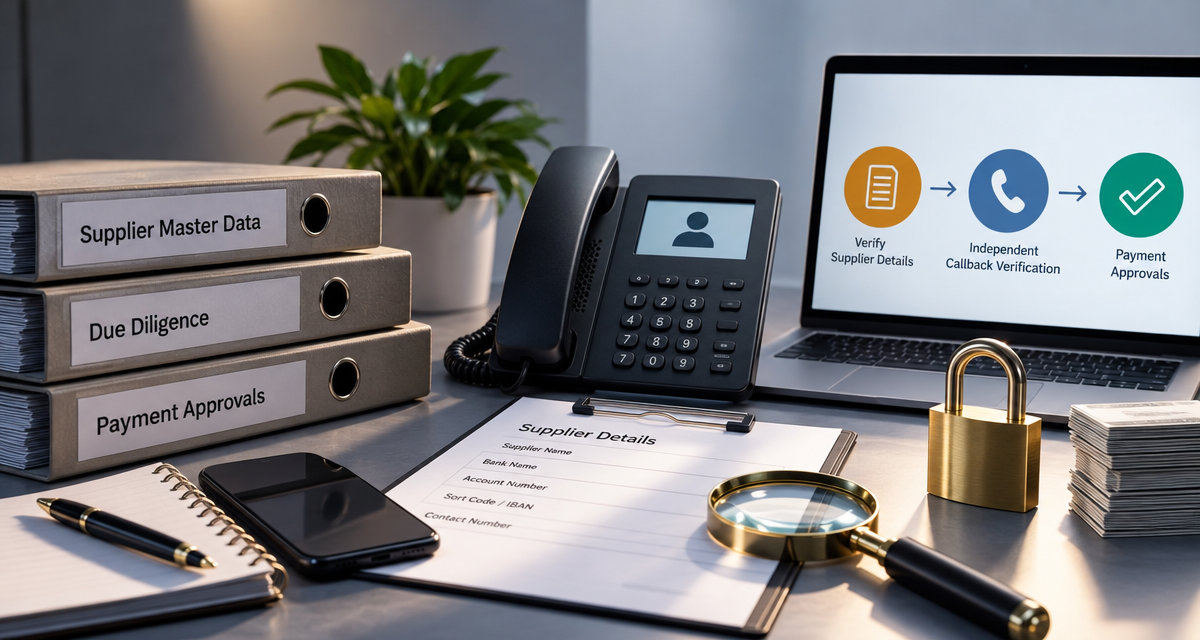
Fake Supplier Bank Details: Build a Payment Verification Process
Supplier payment fraud is soaring. With finance teams handling dozens—or thousands—of vendors, the challenge is no longer just about keeping invoices correct. Attackers exploit email deception, lax data controls, and overloaded staff to hijack legitimate payments, often by slipping in fake bank account details. Building resilient, auditable supplier payment verification processes is now the single greatest control in the AP/Finance arsenal. This exhaustive guide details the workflows, technical challenges, and real-world trade-offs needed to achieve genuine defence—not box-ticking compliance.
Map How Supplier Bank Details Enter Your Business
Most supplier payment fraud originates in a breakdown at the point where account details are created or changed. It’s critical to understand every legitimate pathway—manual, digital, and ad-hoc—by which supplier bank details enter your finance workflow.
- Supplier onboarding forms (paper, PDF, portals): Used by new vendors to submit their preferred bank details. Authenticity checks are often limited.
- Email communication: Requests for changes to bank accounts or new vendor forms; highest risk due to email spoofing vulnerability.
- ERP or procurement platform data uploads (SAP, Oracle, Coupa, Basware): Controlled data inputs, but integrations and updates can suffer from API limitations or missing fields.
- Phone calls or in-person updates: Occurring less frequently, but difficult to validate unless well-documented callback controls exist.
Mapping these flows reveals both technical and human bottlenecks where attackers can intervene. For example, many businesses route supplier onboarding through a shared procurement portal, but allow bank account detail updates to flow in via email “for convenience.” Such process gaps are routinely exploited in large-scale social engineering attacks.
Key friction points: Integrating disparate data entry points into a single, controlled supplier master data repository is complex and requires investment in consistent interfaces, training, and system configuration. Businesses often face compatibility issues with legacy ERPs that lack strong workflow gating or have open-text fields for critical data. Traceability of account changes becomes nearly impossible if these inputs are not tightly regulated from day one.
Recognise Impersonation and Account Change Requests
The vast majority of successful supplier payment fraud incidents begin with an email or document that looks overwhelmingly legitimate—but isn’t. Attackers invest weeks studying communication patterns, invoice layouts, and the subtleties of vendor language. Even experienced AP staff have difficulty distinguishing a genuine request from a highly targeted “vendor impersonation” attack built around real business context.
Signs and red flags include:
- Urgent requests to change only the bank account number, not other vendor details.
- Emails that mimic real supplier addresses (spoofed domains, minor typographical changes).
- Requests that bypass normal supplier contacts, referencing senior staff or “new finance teams.”
- Requests received just before a scheduled payment run, leveraging time pressure.
Technical solutions—like DMARC email authentication, secure supplier portals, and verified sender icons—won’t stop determined attackers, but they can help screen obvious spoofs. Far more critical is embedding a “trust, but verify” mentality in AP teams. Standardising scripts for staff to challenge and validate every supplier-initiated bank change, no matter how legitimate a request appears, transforms behaviour from compliance-driven to skepticism-driven.
Trade-offs: Overly aggressive challenge processes can sour supplier relations and slow payment cycles. Yet, lax standards or “one-off” social exceptions remain the leading cause of multi-million-dollar losses. Balancing speed versus security should be a documented, actively revisited policy—not a silent compromise.
Establish Trusted Supplier Contact Records
The backbone of any robust supplier payment verification program is the “trusted contact” framework: a verified record of who, precisely, is authorised to submit, confirm, or change banking information for each vendor. Without this, any emailed or phoned-in request to alter an account must be treated as suspicious by default.
Best practice workflows include:
- Verifying contact identity on initial vendor setup—using phone calls, corporate directories, or, ideally, in-person meetings.
- Recording multiple, distinct contact points (name, title, corporate phone number, corporate email domain) in the supplier master data file.
- Updating trusted contact lists annually, or upon company M&A, restructuring, or known personnel changes.
Integration challenges: Maintaining synchronised, up-to-date supplier contact data across multiple systems (ERP, procurement, treasury) is technically demanding. Automated integrations to platforms like SAP or Oracle can reduce data drift, but only if workflows force contact record updates before accepting any banking change. Manual maintenance brings higher ongoing cost and “human latency,” but delivers stronger outlier resistance when properly audited.
Ultimately, companies must strike a realistic compromise: The more up-to-date and thorough your trusted contact database, the less friction in verification—but expect significant operational effort to keep this golden record authoritative as your vendor base grows.
Verify Changes Through an Independent Channel
Even the strongest onboarding controls and supplier contact records are meaningless if payment instructions can be changed via insecure methods or manipulated staff. The only proven safeguard is callback verification: independently confirming every bank detail change with a known, trusted supplier contact, through a separate, authenticated communication channel.
This commonly means:
- Calling the vendor’s registered landline number (never mobile) and speaking directly to the pre-verified contact.
- Never using “reply” on an email chain to verify; independently dialing the number you have on file.
- Logging every verification attempt—date, time, user, outcome—in the supplier master data audit trail.
Automation tools—such as AP workflow platforms or secure supplier management portals—can streamline callbacks, but only when integrated with current contact records and change request logic. API limitations are a recurring pain point: if a procurement platform can’t force or record callback verification before updates sync with ERP, manual controls must remain.
Operational risk: During peak payment periods or staff shortages, businesses may be tempted to “fast-track” updates, skipping independent callbacks for “regular” suppliers or “low-risk” regions. These bypasses are the very mechanisms exploited in major fraud cases. Rigor in policy and technology gating is non-negotiable for true supplier payment verification.
Separate Record Changes From Payment Approval
Payment authorisation and supplier master data maintenance must not be handled by the same person or even the same team whenever possible. This separation—or, ideally, “four eyes” control in large organisations—prevents a single point of failure.
Key principles:
- One team updates supplier bank details (after strict verification).
- A different team (or at minimum, a different user) approves or initiates payment runs.
- Audit logs explicitly record user IDs, timestamps, and workflow hand-offs between teams—non-repudiation is crucial for regulatory compliance.
Some organisations employ Coupa, Basware, or SAP modules to enforce separation in workflow. API-connected environments (especially in hybrid cloud/legacy ERP setups) often struggle with enforcing this division, since homegrown integrations may allow updates from within payment screens. Modern AP automation vendors increasingly offer dynamic workflow rules to lock down change/pay/approve flows, but legacy environments often require manual process overlays.
The trade-off is clear: enforcing separation slows down work and can frustrate staff, but the alternative—a single error or malicious insider leading to instant, undetectable loss—remains the costlier risk by orders of magnitude.
Define Controls for Urgent and Overseas Payments
Urgent, last-minute, or “high-value” payments—especially those routed to overseas banks—are frequent targets for supplier bank account fraud. Attackers understand that staff under time pressure or confused by cross-border account formats are more likely to override controls.
Best practice is to define separate, heightened controls for such scenarios:
- Automatic escalation: Any urgent payment request triggers an additional sign-off from a senior finance executive or Treasury.
- Lockout periods: Same-day updates to bank details automatically block payments for 24–48 hours, unless escalated with supporting documentation and independent callback verification.
- Enhanced verification for non-local banks: Require SWIFT confirmation printouts, or use bank account validation services when sending to unfamiliar countries or institutions.
- Record keeping: All deviations from normal workflow are logged with reason codes, supporting evidence, and named approvers.
Here are common controls by payment type and scenario:
| Scenario | Recommended Control(s) | Approval Level(s) | Delay/Lockout | Technical Requirement |
|---|---|---|---|---|
| Standard Domestic Payment | Callback verification; two-person approval | Mid-level Finance | None | ERP workflow enforcement |
| Urgent Payment (Local) | Senior sign-off; callback; audit documentation | Head of Finance | Optional 24h lock | Escalation protocol |
| Overseas Bank Account Change | Independent verification; mandatory waiting period | Treasury/Finance Director | 48h minimum | Integration or manual override |
| Repeated/Suspicious Requests | Freeze supplier record; perform incident review | Fraud or Risk Control | Indefinite | Case management |
Implementation note: Where core ERP platforms are too inflexible, compile separate workflow “bridges” using AP automation or even secure spreadsheet enclaves. Ensure all alternate workflows are documented and governed—shadow processes are a key source of unintentional risk.
Keep Evidence of Verification and Approval
No verification process is effective if it leaves no trace. To comply with audit standards, regulatory requirements, and internal investigations, every supplier bank account modification and payment approval event must be accompanied by formal, tamper-proof evidence trails.
Minimum requirements:
- Digital call or email logs (timestamped, uneditable, referenced to the supplier master entry)
- Signed checklists or “change request” forms, ideally stored as PDFs within the ERP or AP system
- Approval workflow logs showing user IDs, timestamps, and escalation notes
- Where possible, integration with document management or case management platforms (e.g., ServiceNow, SAP DMS) for long-term retention and auditability
Technical friction: Older ERPs lack embedded document or workflow histories; newer platforms (like SAP S/4HANA or Coupa) offer configurable audit fields but may need API customization. Avoid storing critical verification evidence on email servers or local desktops. Cloud storage or integrated DMS solutions provide better searchability and legal compliance.
Trade-off: Rigid evidence requirements must balance against staff workload. Overly burdensome documentation frequently leads to “rubber stamping”—focus on automating evidence capture wherever feasible to avoid user fatigue and gaps.
Rehearse a Suspected Fraud Scenario in Your Singapore Finance Team
No policy or workflow survives contact with real-world attackers—or real staff. On-the-ground simulation is the only way to stress-test your supplier payment verification defences and operational readiness.
How to run a live fraud scenario simulation in a Singapore-based finance team:
- Script a realistic supplier impersonation incident (using a known vendor, plausible timing, and real AP email addresses).
- Ask team members to execute their standard callback and verification process.
- Observe which controls fire as expected—and where staff rely on trust, not process.
- Review whether escalation protocols are triggered on schedule, and whether evidence trails are complete.
- Conduct a group debrief, focusing explicitly on “could this have failed if the request was more sophisticated?”
Critical friction: Staff who have not experienced a real fraud attempt may be overconfident in their ability to spot one. Only repeated, evolving rehearsals build genuine muscle memory and defence. Document lessons learned and update both policy and training programs with each cycle.
Establish Escalation Contacts Before an Incident
Most payment fraud is detected outside the finance team: by a supplier chasing a missing payment, or another department noticing an irregularity. Without a clearly documented, up-to-date set of escalation contacts (across AP, procurement, IT security, and senior management), even a minor incident can spiral into crisis or delayed response.
Best practice:
- Compile a living escalation matrix—names, direct contacts, backup personnel, and areas of responsibility.
- Ensure 24/7 contacts for cross-border, out-of-hours, or high-value payment approvals.
- Communicate escalation protocols regularly to all relevant staff (including supplier managers and IT helpdesk).
- Test the escalation tree biannually, simulating common incident scenarios such as a supplier reporting non-payment or a staff member detecting a suspicious email.
Technical tip: Integrate escalation contacts into workflow tools or supplier management platforms (where possible), and regularly synchronize data with HR and procurement systems to reflect organizational changes. Manual lists are common but highly prone to drift as staff turnover or take on new roles.
Review Exceptions and Strengthen the Process
No supplier payment verification program is static. Attackers adapt; business processes change under pressure. Your process must be anchored in regular review of exception reports, near-misses, and audit findings.
Critical actions:
- Monthly review of all supplier bank change exceptions—what, why, and whether controls worked.
- Root cause analysis of near-miss incidents, focusing on process gaps or user errors.
- Ongoing evaluation of AP automation and supplier onboarding technology for process leakage or integration blind spots.
- Updates to policy, workflows, training content, and technical controls following every identified process weakness or incident.
- Annual “red team” exercises in which simulated attackers attempt to bypass controls with new social engineering tactics or technical exploits.
Trade-off: Excessive exception reviews and process updates create “review fatigue” and confusion; lack of review calcifies vulnerabilities and undermines staff vigilance. Balance frequency and depth with real-world risk exposure and available resourcing.
Comparison Table: Supplier Payment Verification Approaches
| Verification Method | Best Fit Business Size | Implementation Complexity | Fraud Resistance | Technical Integration Needed | Operational Overhead |
|---|---|---|---|---|---|
| Manual Callback Verification | SMB–Enterprise | Low | High (if rigorously enforced) | Minimal (phone/email) | High (staff workload) |
| AP Workflow Automation (e.g. Coupa, Basware) | Mid–Enterprise | Medium–High | High (when combined with strict process) | AP/ERP workflow/API | Medium |
| Supplier Portals with Bank Change Locks | Mid–Enterprise | Medium | High (if trusted contact enforcement present) | Platform integration/APIs | Medium–Low |
| Bank Account Validation API (third-party) | All sizes | Medium | Limited (verifies account, not authority) | API development | Low |
| Rigorous Manual Controls (checklists, logs) | SMB | Low | Medium–High (subject to staff compliance) | None–spreadsheets | High |
Supplier payment verification is a multi-layered challenge. There is no single bulletproof software solution: robust defence comes from integrating technology, rigorous human processes, and regular review of real-world attack techniques. Treat every supplier bank change as a potential fraud attempt, and never accept “business as usual” as a justification to lower your guard.