
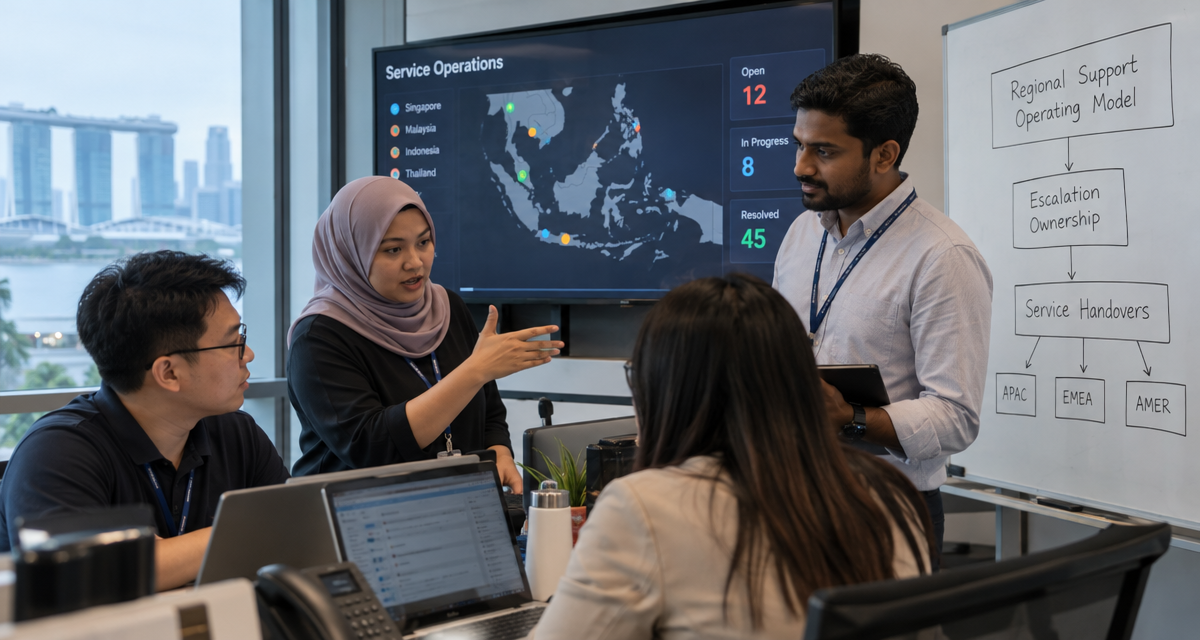
Cross-Border Customer Support: Where Should Singapore Teams Keep Control?
The exponential growth in Southeast Asia’s digital economy, coupled with Singapore’s status as a regional HQ, has turned cross border customer support into a make-or-break capability for enterprises. Deciding which functions and escalation rights to centralise in Singapore—and which to delegate to local markets—impacts resolution speed, customer satisfaction, compliance, and operational cost. Below, we break down the toughest decisions for regional support operating models, expose hidden operational trade-offs, and offer practical guidance on architecting escalation ownership, service handovers, and quality measurement across diverse Asian markets.
Map Customer Demand Across Markets and Channels
Strategically mapping customer demand is the first step to designing effective cross border customer support. The process involves profiling call volume, channel preferences (phone, chat, email, social messaging), SLA expectations, and pain points across geographies. In banking and fintech, for example, Vietnam and Indonesia generate the highest inbound WhatsApp and Messenger support volume, while Singapore and Malaysia customers lean heavily on web chat and email. This divergence exposes a technical friction: omnichannel support platforms must reliably aggregate these channels into unified agent workspaces, but regionally, not every tool or plugin comes with flawless local language integration or telco API reliability.
- Granular analysis by product line: Demand patterns often differ by product (e.g., payment cards vs. corporate treasury), so segmenting support requirements is essential for accurate staffing and routing decisions.
- Scalability risks: Incorrect demand mapping leads to under-resourcing in high-growth markets or wasted capacity in slow markets. Automated queue balancing should account for seasonal surges, campaign launches, and regulatory deadlines.
- Channel enablement: Ensure the chosen omnichannel platforms (e.g., Zendesk, Salesforce Service Cloud, Freshdesk) comply with local data residency and message authentication requirements.
Sample pain point: Real-time translation bots may technically allow Singapore-based agents to serve Thai or Vietnamese chats, but failed nuances in tone or regional phrasing cause higher repeat contacts.
Decide What to Centralise in Singapore
Deciding which core support functions to centralise within a Singapore team demands hard trade-offs between efficiency, cost control, and local relevance. Many enterprises default to centralising first-line tier support, technical troubleshooting for regional platforms, refund processing, and all escalations involving regulatory or financial risk. This streamlines policy enforcement and talent management, but exposes weaknesses in markets with unique compliance or language dynamics.
- Centralised Escalation Management: Benefits include quality consistency, tighter process controls, and reduced training overhead. But complex cases (e.g., local licensing disputes) rarely resolve cleanly without some onshore intervention.
- Shared Service Risks: Highly centralised models may create single points of failure or frustration when Singapore’s limited local market context comes up short, especially during local holidays or after-hours incidents.
- Technical friction: Shared CRM or helpdesk platforms often require sophisticated routing logic to differentiate which cases should remain in Singapore and which mandate local handling. Flaws in this design can lead to escalation ping-ponging and missed SLAs.
Future-proofing: AI-powered sentiment analysis and automated triage will eventually handle more basic queries centrally, but complex dispute resolution and VIP client handling will likely demand human local knowledge for years to come.
Identify Cases Requiring Local Knowledge
The efficiency of centralisation only holds if teams can swiftly identify and re-route cases where local context is essential. Examples abound: identity verification under market-specific law (e.g., Thailand’s eKYC process), government tenders requiring native language documentation, or “red envelope” complaint resolutions during Chinese New Year. Singapore teams must craft precise triggers for local handoff and define what “local knowledge” entails for each product or service line.
- Operational indicators: Include ticket metadata, customer location tags, and keyword detection to identify when local legal, language, or cultural expertise is required.
- Escalation playbooks: Define step-by-step handoff scenarios to minimise customer back-and-forth and ensure legacy case information is preserved.
- Onboarding complexity: Training for both central and local agents must be comprehensive to avoid “knowledge gaps”—central teams must know when to escalate, while local teams must understand context history and next action without manual chase-up.
Practical example: A Singapore agent attempting to process a Vietnamese refund needs to know when unique local refund policies override HQ standard practice.
Define Language and Service Coverage Requirements
High-quality cross border customer support hinges on language specificity and robust coverage windows. Singapore teams commonly provide English, Mandarin, and Bahasa Indonesia coverage, but regional demands may include Vietnamese, Thai, Tagalog, or Japanese—even within the same multinational client base. Determining who delivers what, when, has major technical and operational implications.
- Technical dependencies: Multilingual chatbots and IVRs depend heavily on accurate language models and seamless switchovers. Manual translation support increases ticket handling times and reduces CSAT unless workflows are tightly managed.
- Coverage gaps: True “follow the sun” support often breaks down for less-common languages or public holiday overlaps. Real-world SLAs for Indonesian customers are rarely met with a solely Singapore-based team working standard business hours.
- Vendor limitations: SaaS platforms differ significantly in voice/IVR language support—choose technology stacks (for example, Zendesk vs. Freshdesk or Salesforce) by reference implementation and API flexibility, not marketing claims alone.
Trade-off: Wide language coverage raises cost and complexity. Singapore can provide triage and high-level support, but in-depth local service often requires hybrid staffing or on-call language specialists.
Establish Refund and Complaint Decision Rights
Clear refund and complaint resolution frameworks are central to customer trust. Singapore-led regional support models typically balance autonomy with controls: certain refunds may be auto-approved, mid-sized complaints require Singapore sign-off, while escalations over X SGD or sensitive legal disputes mandate local or regional leadership intervention. Sloppy R&R assignment results in delayed action, errors, or regulatory breaches.
- Escalation criteria: Decision matrices must be encoded into CRM workflows to reduce ambiguity (“When does a 50 USD refund go straight to the country GM rather than Singapore?”)
- Compliance friction: Local banking, data privacy, or consumer protection laws may require approval or documentation only manageable within market geography, not from Singapore.
- Auditability: All refunds and complaints should leave a digital audit trail. Complex handovers and local legal approvals must be fully traceable for regulatory/senior management oversight.
- Process automation: Modern SaaS platforms allow modular rule engines for routing and approval (e.g., in Salesforce Service Cloud), but demand clear customisation to suit ASEAN regulatory fragmentation.
Hidden risk: Over-centralisation in Singapore can create bottlenecks for high-priority market cases; over-delegation to local teams risks inconsistent concessions or non-compliance.
Design Handoffs With Complete Case Context
Service handovers across Singapore and local teams are frequent pain points. Cases routinely lose critical information, leading to duplicate questioning or misaligned responses. Technically, best-practice regional support operating models leverage shared CRMs with embedded context transfer: prior notes, chat logs, attachments, RMA/transaction histories, and assigned agent details travel with the case as it moves between teams.
- Technical friction: Many regional organisations find their helpdesk and CRM infrastructure is not optimised for structured handoffs. Manual email or chat spoon-feeding persists, which is error-prone as service scale grows.
- Operational dependency: Case handoff templates and playbooks should specify required minimum fields—for instance, the last three customer contacts, status of refund/complaint, and specific blockers—to prevent loopbacks.
- Platform integration: Consider whether your SaaS platform supports robust API integration for automated context transfers or requires custom scripting and workflow build-out.
Future-proofing: AI-driven ticket summarisation and context-aware workflows hold promise, but full accuracy in regional ASEAN languages is still evolving.
Review Customer Data Access Before Sharing
Data sovereignty and privacy are alarming sources of technical risk. Singapore-based teams must avoid blind spots when storing, routing, or sharing customer details, especially when data crosses borders. This is a major concern under GDPR, PDPA (Singapore), and country-specific data residency laws (notably in Indonesia and Vietnam).
- Role-based access: Only give local teams access to customer data strictly necessary for their role and jurisdiction. Misconfigured permissions in global CRMs or cloud storage are a common cause of data leakage.
- Encryption and retention: Emails and log files with personal data must be encrypted in transit and at rest. Retention policies for support transcripts should align with local legal requirements—a Singapore default may breach Indonesian or Thai rules.
- Vendor assessment: When using third-party platforms, what is the data hosting model? Do local handoffs cause data to sit on servers in Singapore, the US, or a cloud region at odds with local law?
Operational tip: Regular audits of case-level data flows and permissioning across regional teams prevent inadvertent non-compliance and reputational hits.
Test Escalations Across Country Teams
Robust escalation paths are the backbone of cross-border customer support. Yet, escalation testing is often neglected in favour of process documentation—leaving critical gaps visible only under real customer pressure. Enterprises must simulate high-priority handoffs, complex complaint escalations, and multi-stage (Singapore-local) touchpoints regularly to verify actual, not theoretical, responsiveness.
- Operational weaknesses: Unclear or broken escalation procedures can mean hours or days of dead time as tickets bounce between teams lacking authority, context, or both.
- Technical friction: Platform limitations (absence of push notifications, weak SLA tracking, or lack of activity logs) magnify these delays. Make sure escalation workflows are integrated tightly with team rosters, and visibility dashboards capture turnaround times per handoff node.
- Root cause analysis: Serious process failures typically derive from unclear responsibility boundaries, insufficient escalation triggers, or incomplete context transfer—excessively centralised models are particularly vulnerable to these fault lines in high-growth periods.
Practice tip: Use mystery shopping and live-fire escalation drills to reveal hidden latency and context fragmentation before these affect real customers.
Measure Resolution Quality and Repeat Contacts
True maturity in cross-border customer support is measured not by first contact resolution targets alone, but by outcomes that stick—low repeat contacts, consistent NPS/CSAT improvement, and legally sound complaint closure rates across markets. Enterprises should adopt granular metrics segmented by escalation level, handling hub (Singapore HQ vs. local), language, and channel.
- Core metrics: Resolution Time, First Contact Resolution Rate, Repeat Contact Frequency, NPS/CSAT, Escalation Bounce Rate, Compliance Incident Count.
- Technical dependency: Many SaaS analytics suites require custom configuration to segment and visualise international, language, or product-line quality data. Out-of-the-box reporting typically fails to provide sufficient region-market granularity.
- Calibration loop: Compare Singapore-resolved vs. locally resolved cases for average outcome, SLA breaches, and customer satisfaction. Use findings to adjust handoff triggers and decision rights dynamically.
- Hidden friction: Language and context gaps drive up repeated contacts, especially when Singapore agents handle nuanced local complaints with insufficient domain knowledge.
Future-facing tip: Adopt AI analytics platforms that automatically surface root causes for resolution failures and recommend targeted workflow fixes across the Singapore-local support axis.
Comparative Table: Functions to Centralise vs. Localise in Cross Border Customer Support
| Function/Domain | Centralise in Singapore | Local Team Ownership | Technical Dependencies | Ideal for Business Size/Type | Key Risks/Trade-offs |
|---|---|---|---|---|---|
| Tier 1 Multichannel Support | ✓ (EN, CN, ID; 24/7 possible) | ✓ (for local languages; off-hours) | Omnichannel CRM, translation engine | Medium/Large with regionally standardised ops | Context loss, language mismatch |
| Technical Escalations | ✓ (platform and policy expertise centralised) | ✓ (local regs/custom integrations) | API config, product documentation versioning | Regional SaaS, banking, fintech | Delayed action if not well documented |
| Refund Decisions | ✓ (standard, sub-threshold) | ✓ (sensitive, high-value, legal) | Approval workflow rules, audit trail | All except microbusinesses | Central bottleneck, local compliance risk |
| Complaint Handling | ✓ (policy/process oversight) | ✓ (local nuance, regulator comms) | Support case meta-tagging, SLA timers | Heavily-regulated/consumer sectors | Context errors, missed cultural cues |
| Data Stewardship | ✓ (global architecture) | ✓ (local data sovereignty laws) | Encryption, access control, server location | Multinational/regulated industries | Legal exposure, GDPR/PDPA breach risk |
| Language Handling | ✓ (common/corporate; EN, CN, ID) | ✓ (regional/market-specific) | Multilingual chatbots, local IVR | Pan-ASEAN, country-specific startups | Coverage gaps during local holidays |
| SLA Management | ✓ (central performance tracking) | ✓ (real-time escalations) | SLA engine, dashboard visibility | All cross-border teams | Disjointed reporting, reactive handoffs |
Summary: Best Practices for Cross Border Customer Support Control in Singapore
- Leverage Singapore teams for standard, policy-driven operations, but define tech triggers for swift, context-rich local handoffs.
- Strongly map language, regulatory and channel coverage per market to avoid SLA and compliance gaps.
- Design robust, API-level CRM integrations for context-rich escalations and automated approval flows.
- Audit customer data flows and permission configurations rigorously; adapt handling for evolving privacy laws.
- Regularly stress-test escalation routes and measure outcome quality to avoid recurring friction at scale.
Singapore is uniquely positioned to anchor region-wide customer support, but only with disciplined decentralisation, clear local triggers, and continuous process measurement across handoff points. The right operating model turns regional complexity into competitive advantage—when escalation ownership, language nuance, legal mandates, and case context are all proactively managed.